
The consolidation of mobile devices in the industrial environment has radically transformed the way engineering and maintenance departments interact with the physical world. However, acquiring state-of-the-art hardware (rugged tablets or industrial smartphones) is merely the first step in a much more complex process. The true operational challenge lies in the deployment of the appropriate software. Many operations directors, when auditing their internal processes, face a harsh reality: Does your team waste hours locating faults or filling out paperwork? If the answer is affirmative despite having invested in mobile devices, the problem is not the hardware, but a deficient software ecosystem that is not designed for the rigorous demands of fieldwork.
For years, the industry has attempted to adapt office tools to the outdoor environment. It is common to find maintenance brigades using high-end tablets solely to open PDF files, view static diagrams, or fill out cloud-based spreadsheets that are not optimized for touch screens. Faced with this scenario of technical inefficiency, a critical question arises for Facility Management and urban service leaders: Does the management of your assets depend on obsolete Excels or paper plans? Replacing physical paper with "digital paper" on a screen does not resolve data latency, nor does it eliminate transcription errors; it simply digitalizes the problem. To achieve operational excellence, it is necessary to implement native mobility software that leverages the full sensory, geolocation, and processing potential of the device.
Data Capture and Tactical Inventory in the Field
When technical managers search the market for the best software to inventory assets (from public lighting luminaires to valves in a water supply network) using a tablet, the primary selection criterion must be the fluidity of the interface and the structuring of the data. Maptainer has been conceived under the premise of facilitating 100% digital field operations. This means that the mobile application becomes the epicenter of data collection.
When using a tablet equipped with Maptainer, the technician does not need to type long descriptions in the rain or in noisy environments. The graphical interface allows for the deployment of intelligent, dynamic forms, where the asset's attributes (brand, model, state of conservation, power) are selected through standardized dropdown menus. Furthermore, the larger screen size of a tablet greatly facilitates interaction with the integrated GIS cartography. The operator can geolocate a new element with sub-metric precision directly on the digital map with a single tap, instantly associating its GPS coordinate with the technical data sheet. The result is a parametric inventory, free of human typographical errors, and structured in a way that the technical office can exploit it analytically in real-time.
From Supervision to Tactical Control of Brigades
The second major question that arises in operations management is: How to coordinate and control maintenance brigades in real-time without falling into suffocating micromanagement? In the past, coordination relied on incessant phone calls and radio communications that interrupted the operator's workflow and provided a fragmented view of the situation.
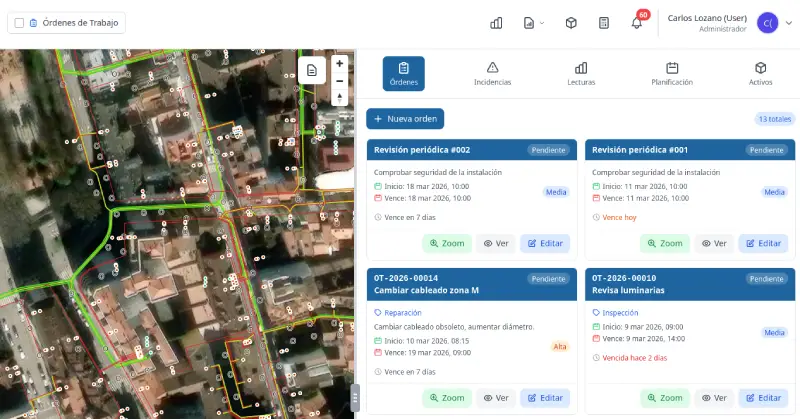
The technological solution involves unification and spatial visibility. Providing a single App for all your brigades allows for the centralization of the information flow. When each technician operates with their tablet connected to the Maptainer ecosystem, the control center has access to a live analytical dashboard. The manager does not need to call the operator to find out where they are or if they have finished inspecting a plant; the system automatically updates the status of the work order and displays the progression of the route on the corporate map. This level of real-time control is a purely tactical tool. It allows the dispatcher to reassign critical-priority emergencies to the brigade that is geographically closest to the incident, optimizing response times (SLAs) and minimizing the empty mileage of the vehicle fleet.
The Technical Imperative: Offline First Architecture
Despite advances in telecommunications, requiring an uninterrupted internet connection to work in the field is a logistical utopia. Field technicians routinely operate in environments that act as veritable Faraday cages: hospital basements, underground industrial plants, shielded boiler rooms, or hydraulic infrastructures in rural areas far from cell towers. If the tablet software requires a continuous connection with the server to open a blueprint or save an inventory, the application will inevitably collapse, destroying the technician's trust in the technology.
To guarantee the viability of the digitalization project, the software must possess absolute structural resilience. Maptainer's operational mandate is clear and direct: Work with or without coverage thanks to Offline First technology and automatic synchronization. This decentralized software architecture allows the tablet's local database to assume total control when the signal fades. The operator can continue inventorying hundreds of assets, opening technical files, taking measurements, and attaching high-resolution photographs without experiencing the slightest lag in the application. The system's intelligence lies in its ability to temporarily store and encrypt these data packets. The precise moment the tablet detects a WiFi network or regains 4G/5G coverage, it initiates an asynchronous background synchronization process. The data flows transparently to the central server, updating the global inventory and notifying the office without the technician having to interrupt their workday to press manual synchronization buttons.
Immutable Evidence and Corporate Legal Protection
Finally, the consolidation of tablet use with advanced software provides the company with an unprecedented legal and commercial defense mechanism. In the provision of technical services, contractual disputes regarding the volume of work executed, intervention times, or the quality of materials are, unfortunately, frequent.
It is imperative that technology acts as an impartial notary of operations: Protect yourself against claims by proving every job done. By utilizing the tablet's high-resolution camera and integrated GPS module, Maptainer mandates the capture of on-site multimedia evidence. Every preventive maintenance action, every repair, and every new inventoried element is digitally sealed with an immutable timestamp and its exact geographical coordinates. Faced with any client claim, an external technical audit, or a discrepancy in monthly billing, company management can extract and present certified reports with a single click. This documentary capability not only deters unfounded claims but projects an image of radical transparency and professional rigor, consolidating client trust and guaranteeing that the hard work performed on the street translates securely and entirely into the company's bottom line.