
The Invisible Threat: Corrosion and Integrity in the Gas Sector
For an Operations Director in the gas sector, asset management is not just a logistical matter; it is a matter of public safety and business continuity. Buried steel pipes are vulnerable to a relentless chemical enemy: corrosion. To combat it, the industry uses Cathodic Protection, a technique that requires constant monitoring of electrical potentials at thousands of "test points" spread across hundreds of kilometers.
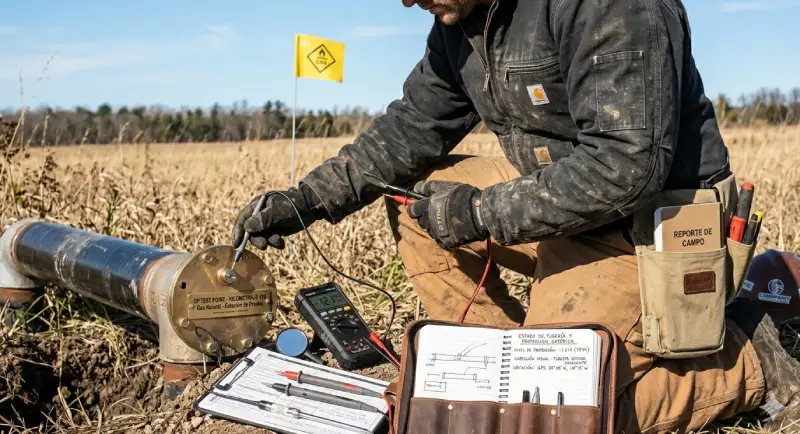
The operational "pain" in this sector is the difficulty of gathering accurate technical data in the field. Historically, technicians followed routes based on schematic blueprints, writing down voltage and amperage readings on paper. This method creates three critical problems: the risk of human error in transcription, the lack of evidence that the technician was actually at the exact spot (vulnerability in audits), and the disconnection between field data and the central management system.
Maptainer: Exact Location of Underground Assets
Implementing Maptainer allows invisible infrastructure to become digitally tangible. By integrating the gas network inventory onto a high-precision GIS engine, technicians do not look for "a yellow post on the road"; they navigate to an exact coordinate with centimeter precision.
When an inspector reaches a cathodic protection test post, Maptainer provides not just the location, but the reading history for that specific asset. The platform allows for the configuration of validated technical forms: the system does not allow closing the inspection if the electrical potential values are outside safety ranges. This "edge intelligence" ensures that any anomaly indicating a pipeline coating failure is detected and reported on the spot, triggering corrective maintenance protocols before corrosion compromises structural integrity.
Offline First Technology: Vital for Remote Pipeline Routes
Pipelines and distribution networks often cross rural areas, deserts, or mountainous regions where network coverage is zero. In cathodic protection management, the technician cannot afford for their work tool to stop functioning due to lack of signal.
Maptainer’s Offline First architecture is the gold standard for these operations. Field crews download the network's vector mapping and inspection routes before starting the day. They can take measurements in the most remote geographical points, record galvanic current data, and attach photos of the asset's physical condition without internet. Once the device detects a stable network, automatic synchronization updates the control center. This eliminates end-of-day administrative work and ensures that integrity engineers have fresh data for decision-making.
Compliance and Legal Security for Regulators
The gas sector is subject to extreme regulatory oversight. In the event of an audit or, worst-case scenario, an incident, the distribution company must be able to prove scrupulous compliance with preventive maintenance plans.
Maptainer acts as a digital notary. Every cathodic protection inspection is recorded with an unalterable timestamp and a validated GPS position. This shields the organization against potential sanctions, providing total traceability: who measured, what they measured, when, and where. The ability to generate automatic compliance reports for the regulator drastically reduces audit costs and raises the safety standard for the entire network.
Digitalizing maintenance in the gas sector is not a luxury; it is the foundation of national infrastructure resilience. By eliminating paper and equipping technicians with GIS tools and offline capabilities, companies do not just protect their pipes against corrosion; they protect their reputation and citizen safety. Maptainer turns cathodic protection management into a precision process, transforming every field reading into a strategic asset for network integrity.