
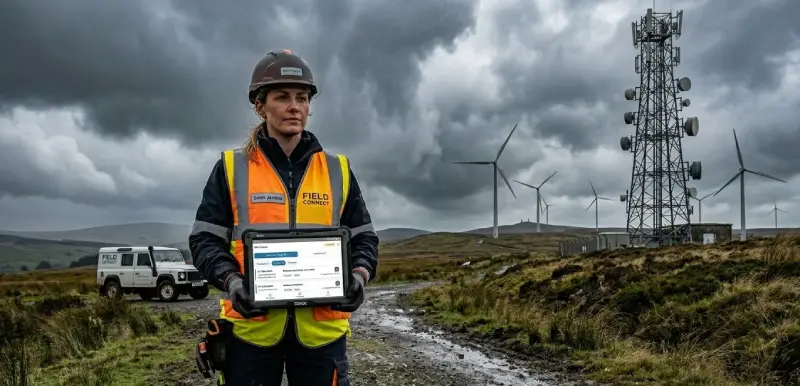
The Myth of Total Connectivity and the Cost of Forced "Airplane Mode"
In the command center of any COO or Municipal Engineer, connectivity is taken for granted. However, the reality for the field technician is radically different. Critical infrastructure is not always located in areas with guaranteed 5G coverage. What happens when a crew must inspect a valve in basement level -3 of an administrative building, or when an electrical maintenance team works at a substation in a rural "coverage shadow"?
In most conventional Computerized Maintenance Management Systems (CMMS), the answer is operational collapse. If the application depends on a constant connection to the server, the technician is forced to revert to paper or rely on their memory to record data hours later back at the office. This not only generates inefficiencies but introduces a critical risk: the corruption and loss of data integrity. 100% digital field operations require an architecture that does not stop when the signal disappears. The mandatory question for any operations manager is: Is your team losing hours locating faults or filling out paperwork?.
What is Offline First Technology?
"Offline mode" (a functionality added as a patch) should not be confused with an Offline First architecture. While the former tries to save a local copy when the network fails—often with cache errors—Maptainer’s technology is designed so that the mobile device (tablet or smartphone) functions as the primary data node autonomously.
Robust Local Database: The device stores all GIS mapping, technical forms, and asset history locally. The technician does not "consult the cloud"; they consult their device. This eliminates data latency and transcription errors.
Atomic and Intelligent Synchronization: As soon as the system detects a minimal connection (even 2G or a momentary Wi-Fi network), the software starts a background synchronization process. It doesn't send heavy files, but rather "deltas" of information (only the changes made), ensuring that battery and bandwidth are maximized.
Edge Conflict Resolution: If two technicians modify the same asset simultaneously in zones without coverage, Maptainer's synchronization engine uses advanced algorithms to merge data without information loss, based on immutable timestamps.
Eliminating the "Pain" for Technicians and Managers
Using tools that fail without internet penalizes team morale and project profitability. By implementing a native Offline First solution, three major inefficiencies are eliminated:
"Double Data Entry": No more transcribing notes from paper to Excel upon returning to base. The technician completes the report on-site, with photos and exact GPS coordinates, regardless of whether they are underground or in the middle of a forest.
Operational Uncertainty: The office manager receives updates automatically as soon as the technician regains signal. This allows for immediate billing and total transparency towards the end client.
Legal Security and Integrity: Every intervention is sealed with a timestamp and locally validated GPS coordinates. Protect yourself against claims by proving every job done.. If a repair was performed at 10:00 AM in a dead zone, the system will certify that exact moment.
Resilience as a Standard in Industry 4.0
For a Facility Manager or a Smart City official, technology cannot be an obstacle. Field digitalization is only real if it is resilient. Maptainer offers more than just an intuitive interface; it provides the assurance that the data flow will never be interrupted. In an industrial environment where downtime is measured in thousands of euros, having a tool that guarantees work continuity under any circumstance is the difference between leading the sector or staying trapped in the analog past.