CMMS projects do not fail because of the software. They fail at implementation.
Months spent configuring asset types, symbology and forms from scratch. An inventory nobody ever finishes loading. A team that has not seen the system until go-live day. And a pilot that stays a pilot because nobody used it in earnest. The Maptainer implementation programme is built so that does not happen: we load, configure and train, and everything we commit to is put in writing before we start.
It is an exchange. It is not for everyone.
- It fits if you are going to put it into production With your real operation and your technicians in the field, not in a side environment someone checks now and then.
- It fits if you can spare time to tell us what is not working Regular sessions with someone who knows the operation. Without that, the programme loses its point.
- It does not fit if you want a pilot nobody will use We only start implementations that are headed for production. A pilot nobody uses helps no one, including you.
You do not set up the project. We do.
- Initial load of your cartography We import your inventory from whatever format it is in: GeoPackage, Shapefile, GeoJSON, DXF or CSV. If it lives in another system with an API, we set up the connection.
- Configuration of types and forms We start from the pre-configured vertical closest to your operation and adapt it to your reality, not the other way round. You do not start with an empty database.
- Team training Managers, planners and field technicians. The app can be learned in a morning; the operation takes longer, and that is where we stay alongside you.
- Direct access to the people who build it No first-line support layer. When something does not fit, you talk to someone who can change it, and your decisions carry weight in what gets built next.
- Entry pricing A programme price, held for the agreed period. It is our side of what we ask from you in return.
And this is what you put in.
- Real use in production With your operation, your technicians and your real work orders.
- Regular feedback Regular sessions to tell us what gets in the way, what is missing and what is surplus. It is the part of the exchange that is most valuable to us.
- Permission to publish the case Once there is enough track record, and with the scope we agree. You can hold back figures and sensitive details.
Before we start, four things are put in writing.
No "we will figure it out as we go". If it has not been agreed, it is not part of the programme.
Scope
Which assets are included, how many users and which modules are switched on.
Duration
The period with entry pricing and what happens when it ends.
Milestones
Data load, configuration, training and go-live, with dates.
Exit criteria
What has to be working for the implementation to be considered complete.
If it is not in production by the signed date because of us, you do not pay for the implementation.
Whoever proposes a CMMS inside their company risks more than money: they put their word on the line in front of management. That is why we carry the implementation risk, with a date and conditions in writing.
- A signed go-live date Set in the implementation plan before we start, with its intermediate milestones.
- "In production", defined without ambiguity Your inventory loaded and validated by sampling, with fewer than 2% load errors. The team trained. And two consecutive weeks of real work with at least 80% of work orders handled in Maptainer. We check it together; we do not just declare it.
- You pay for the implementation by milestone 30% when the plan is signed, 30% once the data is loaded and the remaining 40% only when the exit criteria are met.
- The subscription is billed from go-live Not from signature. Until it is in production, you do not pay for a system you are not yet using.
- If we miss it because of us, you choose We refund what you paid for the implementation and you leave with your data, or we keep going at no extra cost until it is in production.
The guarantee has one condition: that your side is met too. Data delivered on time, a contact person with time available and the team available for training. If any of that slips, the date moves by the same amount, and that is put in writing.
A system you can read end to end before you sign anything.
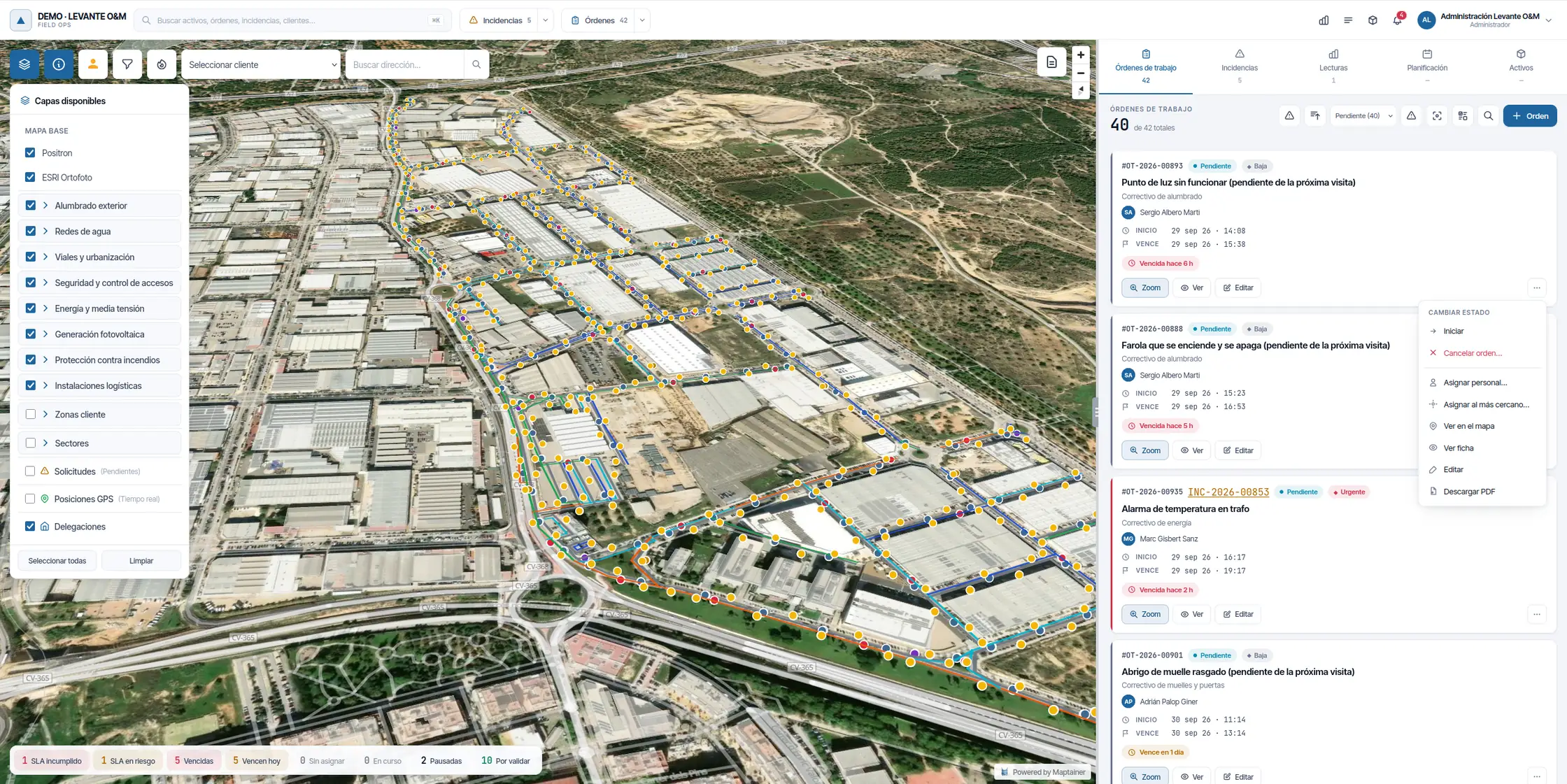
A CMMS with native GIS: twenty-five functional modules, four ways to use it — web, mobile, customer portal and public API — and a self-hosted geospatial stack with PostGIS, Valhalla, VROOM and Planetiler.
The complete functional documentation is public and the API reference is open, with no key required. Before the first conversation you can check what the system does and what it does not.
Write to us with four details.
How many technicians you have in the field, roughly how many assets you maintain, what format your inventory is in today and what costs you most in your current operation. With that, one conversation is enough to tell you whether we are a fit.
If we are not a fit, we will tell you. We would rather do that than start an implementation that is not going to work.
Last updated:
Tell us about your operation.
The four details above are enough to know whether the programme makes sense for you.