
You do not discover a contract's margin at the end of the quarter. You lose it on the road, one work order at a time.
You budgeted for materials and hours. The kilometres went into overheads, as always. Then the books close, the contract that looked good was not, and nobody can say which jobs the money went on. In distributed maintenance, travel is a large part of the cost of every job, and it is almost never measured.
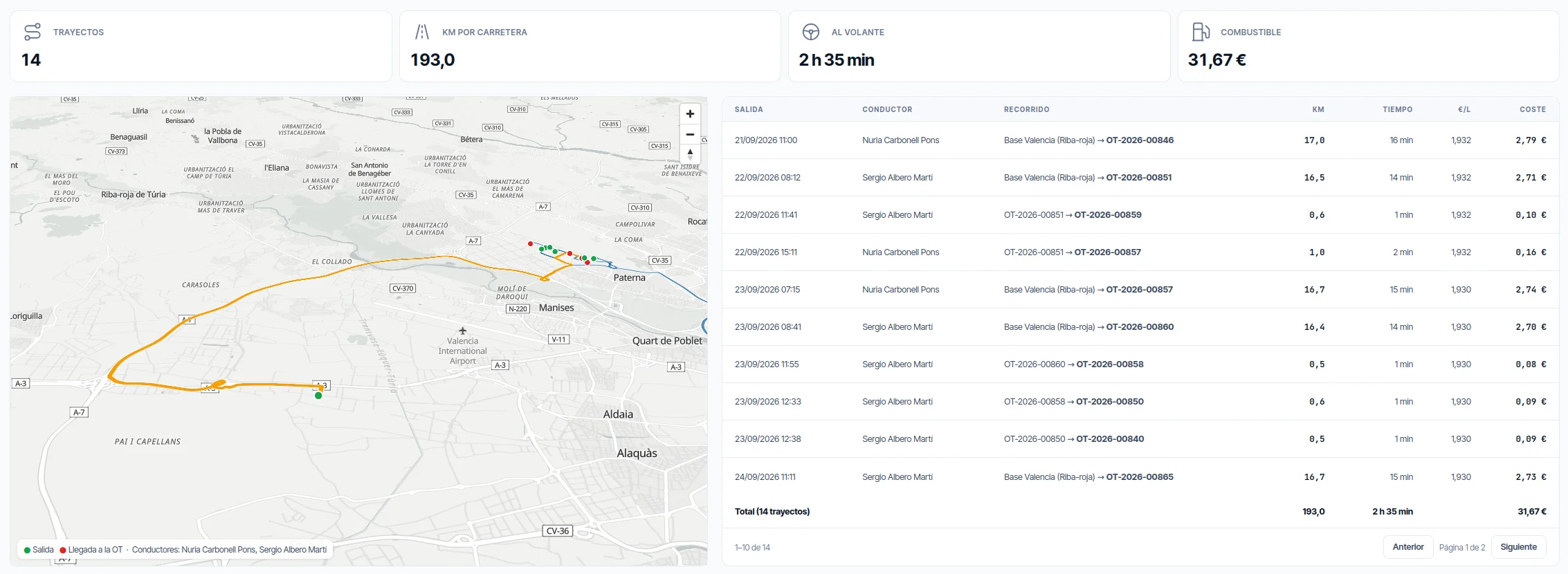
With the fleet module, every closed work order knows what it cost to get there: real road distance, the vehicle that made the trip and fuel at that day's price. Without anyone logging kilometres and without installing anything in the vehicle.
What stops happening to you.
- You stop defending the margin with an estimate. Travel cost is charged to the work order that generated it. In front of management or your customer you show the leg, its kilometres and its cost, not a pro-rata split worked out after the fact.
- You stop watching the history change by itself. The cost of each leg is frozen when it is generated. If diesel goes up in March, January's work orders still cost what they cost.
- You stop chasing mileage sheets. The leg is calculated and costed automatically when the technician reaches the work site. Nobody has to remember to log it.
- You stop asking who had the van. Vehicle assignment is always explicit, and a vehicle cannot be assigned to two people at once.
The day's price, frozen into the leg.
The price can come from your own rate, the one in your fuel supply contract, or from the official index, which the system downloads every 30 minutes from the API of the Ministry for Ecological Transition (the Spanish government department that publishes fuel prices). If you do not set up a rate, you still get realistic, up-to-date costs.
When a route leg is generated, its cost is stored as a snapshot, not as a reference to the current price. This is deliberate: if diesel goes up 20% in March, the cost of January's work orders cannot change retroactively. A history that rewrites itself is no use for closing a contract or defending a margin.
The kilometres charged are the ones actually driven.
Each trip generates a leg with the real distance and duration returned by Valhalla on the road network, the route polyline to draw it on the map and the cost snapshot. The routing is our own: your staff's positions are not sent to an external map provider.
The times do not depend on someone pressing a button.
This is where data quality comes from. And it is what the analytics rely on afterwards.
They reach the work site
When the geofence detects entry, the work order switches to "in progress" on its own, with geolocated evidence.
The leg is generated
The trip is calculated and costed with no input from anyone, and charged to that work order.
The working day ends
Open work orders are paused when the shift closes, with a notification.
Something stalls
The system flags whatever has gone too long without progress.
What it takes for the calculation to come out right.
- Consumption consistent with fuel type The system requires the declared consumption to match the vehicle's fuel type. An inconsistent figure here would carry the error into every leg.
- An odometer that updates itself From the recorded trips, without anyone having to log it.
- Mobile warehouse The vehicle can carry its own stock, which is deducted when material is used on the work order.
- Assignment by QR code, manually or by the supervisor The technician scans the vehicle's code at the start or picks it in the mobile app; in fleets with fixed allocation, the supervisor assigns it from the web.
Opening a new assignment automatically closes the previous one. Automatic vehicle inference from telemetry has been withdrawn: assignment is now always explicit.
Frequently asked questions
Do I need to install a device in the vehicle?
What about the privacy of staff location data?
Is Fleet and costs a separate module?
Last updated:
You know what each work order costs. Now, what to do with that data.
The same automations that cost the travel also record the intervals that wrench time is built from.