
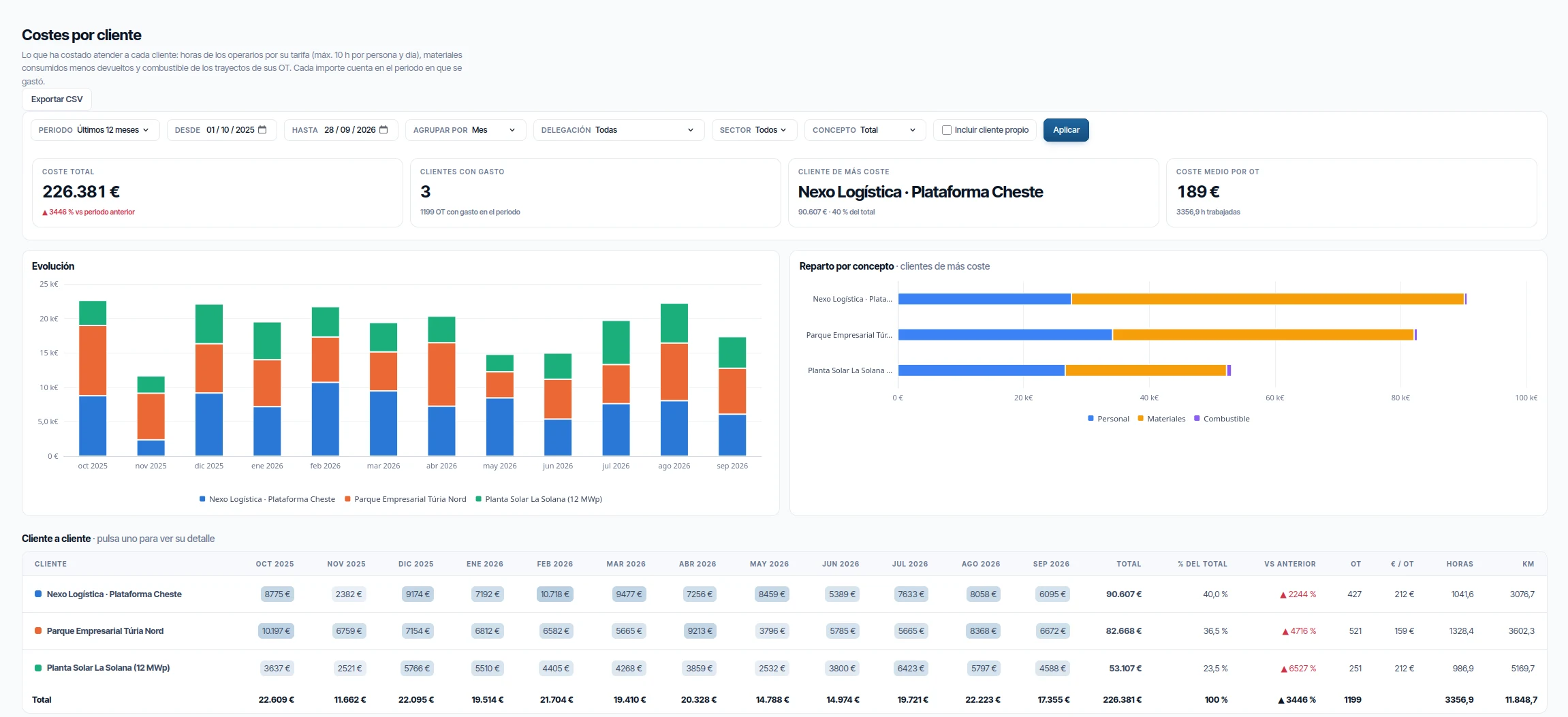
One of your contracts is eating your margin. You will find out at renewal.
The overall figure adds up, but inside it some contracts are paying for others. Every month someone loses hours building a customer report out of loose job sheets and photographs. And the extra job the technician sorted out on the spot never gets billed, because it never reached the office. Maptainer charges the true cost to each work order, captures the evidence while the work is being done and treats each customer as what it is: a separate contract.
It is for you if
- You are a maintenance contractor or technical services company of 10 to 150 people With several contracts running at once and teams spread across the territory.
- Your customers hold you to account Reports on the work done, deadlines met, before and after photographs. And with less patience every time.
- You want to negotiate renewals with data The margin on each contract worked out from what each work order actually cost, not from an allocation of overheads.
It is not for you if
- You are looking for invoicing software Maptainer calculates the true cost of each work order and rolls it up by customer, but it does not issue invoices or quotes. That stays in your business management system.
- Your contracts are for maintenance inside a building The data model is built for territory and networks, not for the floors and rooms of a property.
- You want each technician to keep filling in the job sheet back at the office Evidence is captured in the field, while the work is being done. If the way you operate does not change, the system is no use.
You reach the renewal knowing what each customer has cost you.
Each work order builds up materials at the true cost of the warehouse movement, hours at the cost of the person who worked them and kilometres priced at that day's fuel price, taken from the official API of the Ministerio para la Transición Ecológica (Spain's Ministry for the Ecological Transition).
Rolled up by customer, the margin stops being a year-end estimate and becomes a figure you can negotiate with. The contract that subsidises the rest shows up while you can still do something about it.
No more building the customer report at the end of the month.
When evidence is pieced together afterwards, it is pieced together badly and late. Here it is generated while the work is being done, without asking the technician for anything extra.
- Arrival recorded automatically The work order switches to "in progress" when arrival at the site is detected, with position and time recorded without anyone touching it.
- Before and after photographs Georeferenced and timestamped, inside the field form itself.
- Sign-off in the field A handwritten signature on the device, with GPS, date and device details.
- What gets done gets billed Even when the technician works offline, the photographs and the signature enter the system on reconnection. Nothing sits in a notebook waiting for someone to type it up.
- Reports per customer Filtered by their scope, with export. The report that used to be assembled by hand comes out of a filter.
The SLA is calculated on what happened, not on what someone declared at closure.
You define the SLA per customer, with its criticality levels and its response and resolution times. Compliance is calculated on the status history of each incident. When the customer disputes a deadline, you have the record, not a version of events.
It is not a "customer" field on the work order. It is the structure of the system.
The difference between tagging and modelling shows the day a customer asks for a report on their asset base, or the day you have to give someone on their team access without them seeing the next customer's data.
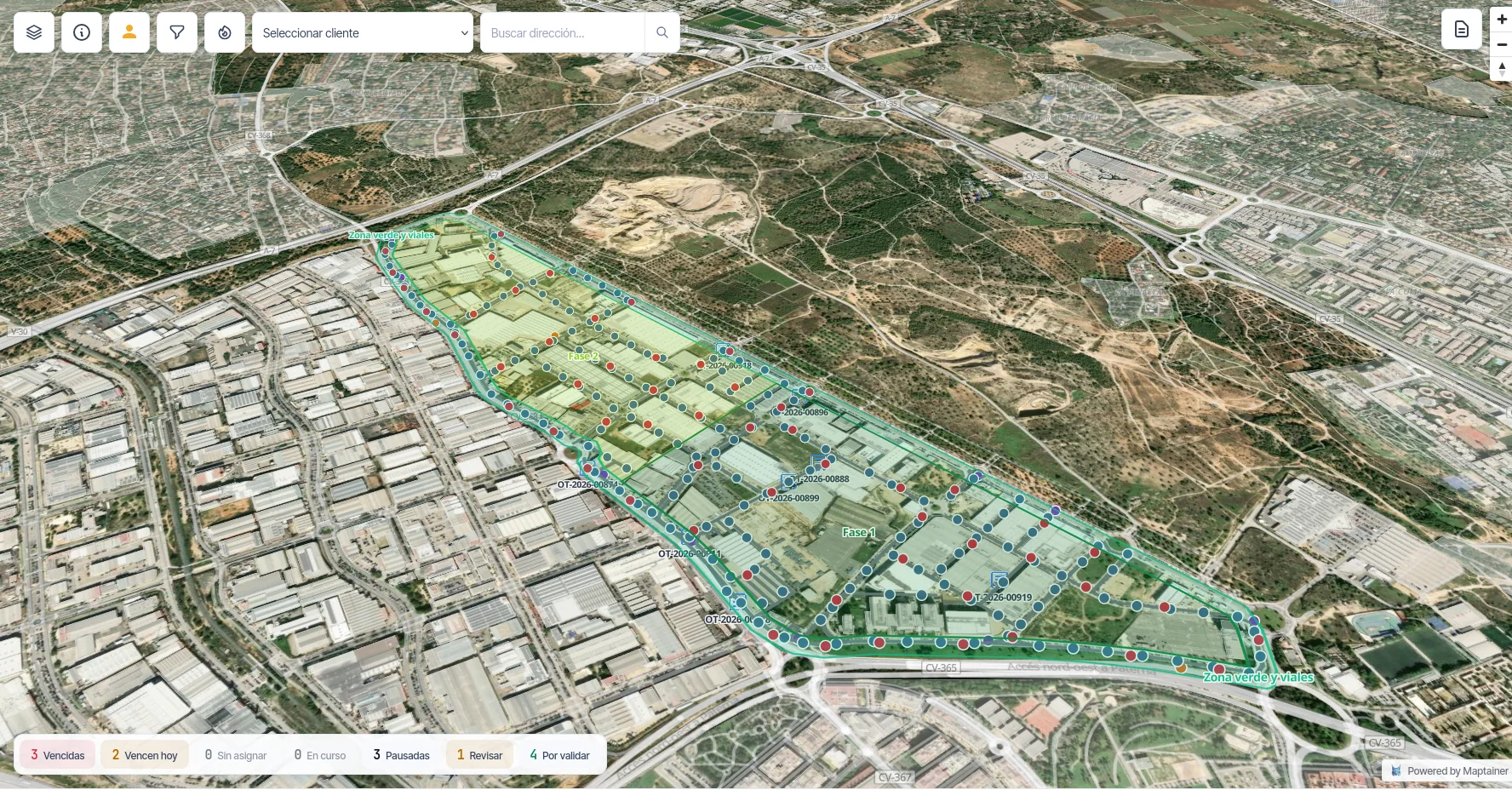
Each customer has its own geographic scope, assets, SLA with its criticality levels and deadlines, portal and logo. Filters, reports and permissions respect that boundary natively.
- Customer zones The territorial scope of each contract, drawn on the map.
- Branches Your territorial organisation, with its warehouses and its own holiday calendar.
- Sectors and zonings The operational division you use to distribute work, independent of the customer's.
Your customer stops phoning to ask how their work is going.
They log in to their portal, with their logo, and see their assets on the map, the status of their work orders and their SLA. If they have an incident, they open it themselves by marking the spot and attaching photographs.
You stop being the supplier who sends PDFs. And the portal stops being a platform cost and becomes part of what you sell at renewal.
The hidden cost of a CMMS is not the licence. It is the project.
Setting up asset types, symbology, maintenance types, tasks and forms from scratch is a months-long project nobody budgeted for. That is where most implementations fail, not in the software.
Preconfigured verticals come with all of that done. When your organisation is set up, they are cloned into your workspace and become yours to edit. You start with a system that already knows what a streetlight or a pump is, not with an empty database.
Frequently asked questions
How many customers can I have in the system?
Can I invoice from Maptainer?
How long does an implementation take?
Last updated:
A demo prepared for a portfolio like yours.
Tell us how many technicians you have in the field, how many customers you serve and what kind of assets you maintain. With that, we prepare the session on a demo environment similar to your portfolio.